
Some people notice an unusual pattern when they exercise. As they begin walking briskly, climbing stairs, or jogging, they experience chest discomfort or tightness. Surprisingly, if they slow down briefly or continue exercising, the discomfort fades and they are able to continue without further symptoms.
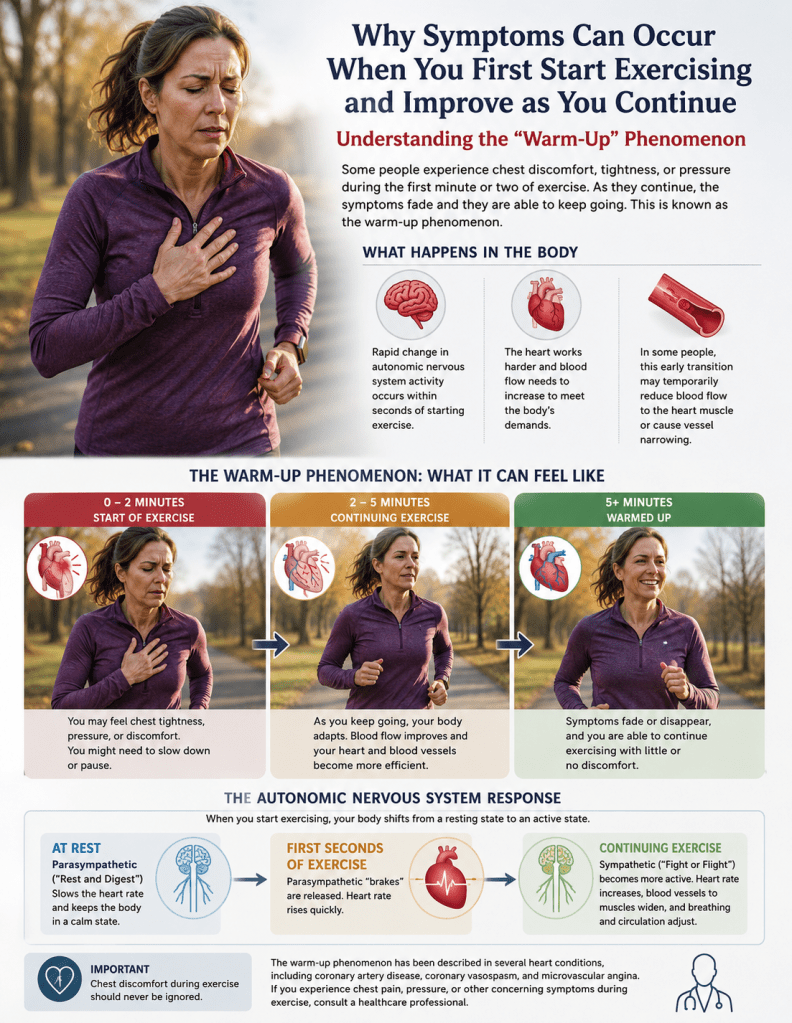
This pattern is known as the warm-up phenomenon and, in people with certain forms of angina, is often referred to as warm-up angina. Although researchers continue to study why this occurs, one possible contributor is the rapid change in autonomic nervous system activity that takes place during the first moments of exercise.
Your Body Changes Within Seconds
The autonomic nervous system controls many automatic body functions, including heart rate, blood pressure, breathing, and the diameter of blood vessels. It has two major components:
- The parasympathetic nervous system, which keeps the body in a resting state.
- The sympathetic nervous system, which prepares the body for physical activity.
When you first begin exercising, these systems shift rapidly.
The First Few Seconds of Exercise
At rest, the parasympathetic nervous system acts like a brake on the heart, keeping the heart rate relatively low. As soon as you start moving, this brake is released, allowing your heart rate to increase almost immediately.
Within seconds, the sympathetic nervous system becomes more active. This causes:
- A faster heart rate.
- Stronger heart contractions.
- Increased blood flow to the working muscles.
- Wider airways to improve oxygen delivery.
- Increased sweating to regulate body temperature.
These changes normally help the body adapt to exercise efficiently.
Why Might Symptoms Occur Only at the Beginning?
For some people, the transition from rest to exercise is when symptoms occur. Several mechanisms may contribute, including:
- Sudden changes in autonomic nervous system activity.
- Temporary mismatch between the heart’s oxygen demand and blood supply.
- Coronary artery disease.
- Coronary artery vasospasm.
- Microvascular dysfunction.
- Certain exercise-related electrical conduction abnormalities.
Researchers believe that once exercise continues for a few minutes, blood flow to the heart often becomes more efficient, blood vessels may dilate further, and autonomic activity stabilizes. As a result, symptoms may lessen or disappear despite continued exercise.
The Warm-Up Phenomenon
The warm-up phenomenon has been recognized for many years in cardiology. Some individuals with stable angina find that after an initial episode of chest discomfort, they can continue exercising with fewer or no symptoms. This effect has also been described in other cardiovascular conditions, although the exact explanation may differ from person to person.
Scientists believe the phenomenon is likely due to a combination of improved coronary blood flow, better matching of oxygen supply to demand, and changes in autonomic nervous system regulation.
An Important Reminder
Chest discomfort that occurs during exercise should never be ignored. While the warm-up phenomenon has been described in medical literature, exercise-induced chest pain can have many causes, some of which require prompt medical evaluation.
If you experience new, worsening, or unexplained chest discomfort during physical activity, you should seek assessment by a qualified healthcare professional.
The Bottom Line
The autonomic nervous system begins responding within seconds of starting exercise. In some individuals, these rapid physiological changes may contribute to symptoms that occur only at the beginning of activity. Although autonomic regulation is unlikely to be the only explanation for warm-up angina, it may be one important piece of a much larger puzzle that researchers are still working to understand.
References
1. Williams RP, Manou-Stathopoulou V, Redwood SR, Marber MS. (2014). “Warm-up Angina”: Harnessing the Benefits of Exercise and Myocardial Ischaemia. Heart, 100(2), 106–114.
A comprehensive review of the history, physiology, and proposed mechanisms behind the warm-up phenomenon. This is probably the single best review article on the topic. (PubMed)
Read:
2. Tomai F. (2002). Warm-up Phenomenon and Preconditioning in Clinical Practice. Heart.
An excellent overview discussing possible mechanisms, including ischemic preconditioning, myocardial blood flow, oxygen demand, and clinical implications. (PMC)
Read:
3. Bogaty P, et al. Myocardial Perfusion Imaging Findings and the Role of Adenosine in Warm-Up Angina. Journal of the American College of Cardiology.
This study demonstrated that warm-up angina occurs even without major changes on myocardial perfusion imaging, suggesting that the mechanism is more complex than simply increased blood flow. (JACC)
Read:
4. Stewart RAH, et al. (1995). Time Course of “Warm-Up” in Stable Angina. American Journal of Cardiology.
Examines how long the protective warm-up effect lasts after an initial bout of exercise. (AJC Online)
Read:
5. Tomai F, et al. (1996). Mechanisms of the Warm-Up Phenomenon. European Heart Journal.
One of the classic physiological studies investigating why the heart tolerates exercise better after the initial exertion. (OUP Academic)
Read:
6. Joy M, et al. (1987). Observations on the Warm-Up Phenomenon in Angina Pectoris.
An early landmark study documenting improved exercise tolerance after an initial episode of exertional angina. (PMC)
Read:
A Note for Readers
The classic “warm-up angina” described in these studies was investigated primarily in patients with obstructive coronary artery disease. However, researchers are increasingly interested in whether similar warm-up symptoms may occur in people with coronary microvascular dysfunction, coronary vasospasm, autonomic dysfunction, and some individuals with post-COVID (Long COVID) syndromes. The mechanisms in these conditions are still being investigated and should not be assumed to be identical to those seen in obstructive coronary disease.
That final note is important because it accurately distinguishes the well-established evidence for warm-up angina in coronary artery disease from the more speculative—but increasingly discussed—possibility that similar symptoms in people with structurally normal hearts may involve microvascular dysfunction or autonomic abnormalities.

 Simon R. Downes, MD, PhD