
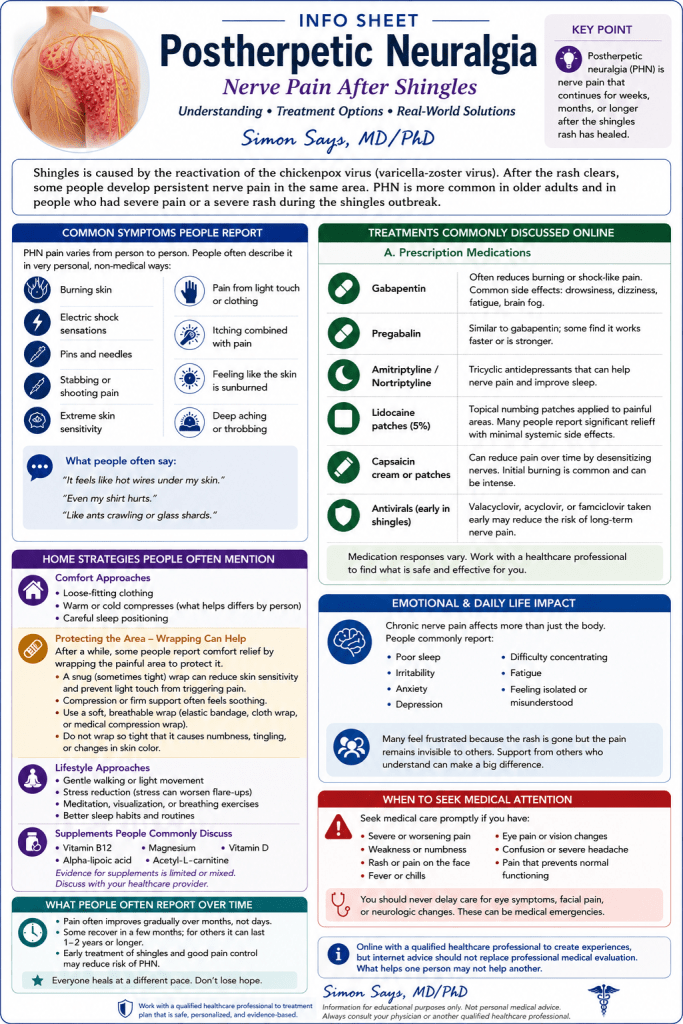
Many people are surprised to learn that the pain from shingles can continue long after the visible rash disappears. This condition, called postherpetic neuralgia (PHN), occurs when irritated or damaged nerves continue sending pain signals even after the skin has healed. For some individuals the discomfort is mild, while for others it can become severe enough to interfere with sleep, concentration, clothing tolerance, and daily activities.
Online communities and support groups often contain vivid descriptions of what this pain feels like. Instead of medical terminology, people describe sensations such as “electric shocks,” “burning wires,” “glass shards,” or “skin on fire.” One of the most frustrating aspects for many individuals is that the pain remains invisible to others even though the nervous system is still irritated.
Discussions online frequently mention medications such as gabapentin, pregabalin, amitriptyline, lidocaine patches, and capsaicin creams. Responses vary considerably from person to person. Some report major relief, while others struggle with side effects such as fatigue or dizziness. Many people also discuss lifestyle adjustments including stress reduction, meditation, careful sleep positioning, loose-fitting clothing, and gentle exercise.
One interesting comfort strategy commonly mentioned by patients is protecting or wrapping the painful area. Some individuals report that after the initial severe sensitivity settles down, a soft but supportive wrap can reduce irritation from clothing or movement. In certain cases, a snug wrap or light compression feels calming and protective to the nervous system. People often describe the sensation as “holding the nerves still” or reducing triggering from light touch. However, wraps should never be tight enough to impair circulation, cause numbness, tingling, or skin discoloration.
Recovery from postherpetic neuralgia can be unpredictable. Some people improve within a few months, while others experience symptoms much longer. Early treatment of shingles may reduce the risk of persistent nerve pain, but not everyone responds the same way.
Although online communities can provide valuable support and practical coping ideas, it is important to remember that internet discussions are not a substitute for professional medical evaluation. Persistent pain, facial symptoms, weakness, eye involvement, or worsening neurologic symptoms should always be medically assessed.
Simon Says, MD/PhD
Educational information only. Not personal medical advice.

 Simon R. Downes, MD, PhD