

In a world that constantly pushes us to want more, do more, and be more, it’s easy to overlook what we already have. We move from one goal to the next, rarely pausing long enough to notice the quiet positives in our daily lives.
“Counting your blessings” may sound old-fashioned, but psychologically, it’s one of the most powerful tools for improving mental well-being. It shifts your brain’s focus away from stress, scarcity, and comparison—and toward stability, meaning, and appreciation.
This isn’t about ignoring problems. It’s about balancing your perspective.
Why It Works
Your brain has a natural tendency toward negativity. This is called the “negativity bias,” and it helped humans survive by focusing on threats. But in modern life, it can leave us stuck replaying worries, frustrations, or what’s missing.
When you consciously count your blessings, you are training your brain to notice what is working, not just what isn’t.
Over time, this can:
- Reduce stress and anxiety
- Improve mood and resilience
- Strengthen relationships
- Increase overall life satisfaction
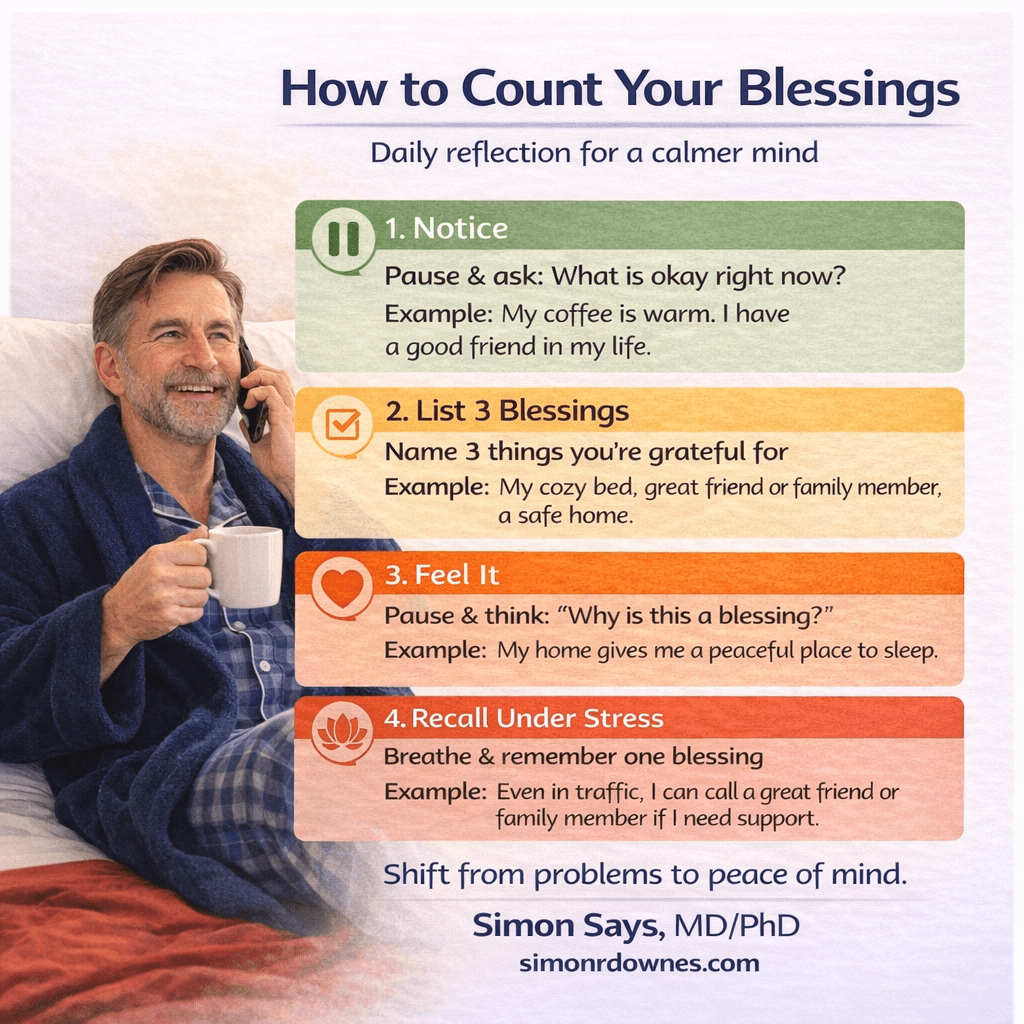
Step 1: Slow Down and Notice
Most people don’t lack blessings—they lack awareness of them.
Start by pausing, even for a minute. Look around your current moment.
Ask yourself:
- What is okay right now?
- What is not hurting, not broken, not urgent?
Sometimes, your blessing is as simple as:
- A quiet room
- A warm drink
- Your health holding steady today
Small counts.
Step 2: Name Three Things (Daily Practice)
A simple structure works best.
Each day, identify three things you are grateful for. They can be:
- Practical: “I have a stable job”
- Relational: “Someone checked in on me”
- Personal: “I handled stress better than yesterday”
Write them down if you can. There’s something powerful about making it concrete.
Step 3: Feel It (Not Just List It)
This is where most people miss the benefit.
Don’t just list your blessings—pause and feel them.
Ask:
- Why does this matter to me?
- What would life feel like without this?
Even 10–15 seconds of reflection helps your brain encode the experience more deeply.
Step 4: Use It During Difficult Moments
Counting your blessings isn’t just a morning routine—it’s a tool.
When stress hits, try this:
- Pause
- Take a breath
- Identify one thing that is still stable or supportive
This doesn’t eliminate the problem, but it prevents your mind from collapsing into “everything is bad.”
Step 5: Keep It Real
This is not about fake positivity.
You can acknowledge:
- “This situation is difficult”
and - “I still have some things going right”
Both can exist at the same time.
That balance is where mental strength lives.
Final Thought
You don’t need a perfect life to feel grounded. You just need to notice what’s already holding you up.
Counting your blessings doesn’t change reality—it changes how you experience it.
And that can change everything.

 Simon R. Downes