
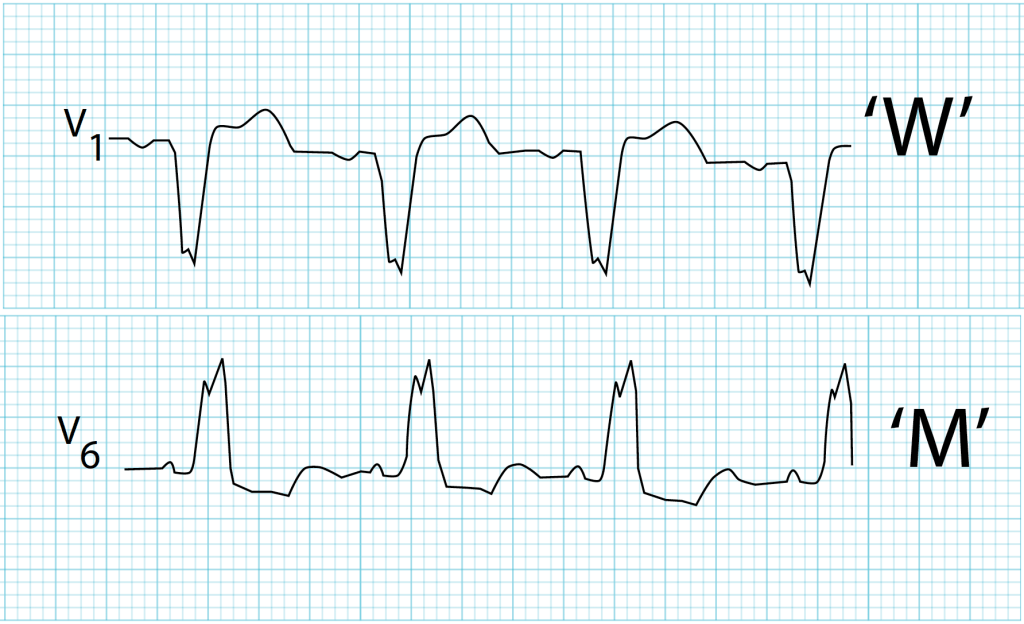
A 68-year-old man presents to the emergency department with progressive dyspnea on exertion and episodes of lightheadedness over the past few weeks. His medical history is significant for hypertension and type 2 diabetes mellitus. His vitals are stable, and a physical exam reveals an S3 heart sound. An ECG is obtained and shown below.
Which of the following is the most appropriate next step in management?
A) Empiric anticoagulation
B) Permanent pacemaker implantation
C) Cardiac resynchronization therapy (CRT)
D) Beta-blocker therapy
E) Coronary angiography
Explanation:
The ECG demonstrates Left Bundle Branch Block (LBBB) with a wide QRS complex (>120 ms), notched R waves in leads V5 and V6, and deep S waves in V1. The presence of dyspnea and an S3 heart sound suggests heart failure with reduced ejection fraction (HFrEF).
For patients with LBBB and symptomatic heart failure with reduced ejection fraction (LVEF ≤35%), the best treatment is Cardiac Resynchronization Therapy (CRT) (Choice C), as it improves cardiac efficiency and reduces heart failure symptoms.

 Simon R. Downes